Logged in as: Anonymous User sign in
Research_banner
Csl_research
 
Printer Friendly Format


Geophysics & Petrophysics

Petrophysics is the study if the physical properties of the rocks. The main goal of our petrophysical studies is assessment of the controlling parameters, such as porosity, pore structures, pressure, saturation and mineralogy on sonic velocity and permeability in carbonates. Understanding the relative importance of all these parameters is important to assess the uncertainties that arise when using theoretical equations to interpret or predict velocity, porosity and permeability trends from subsurface data sets. 
Our current focus is to test several assumptions in rock physics. For example, experiments have revealed that the basic assumption in Gassmann’s equation, which says that the dry and wet shear moduli are constant, needs to be questioned in carbonates. A series of projects address the causes for this shear modulus variability and the effect of saturation on sonic velocity in carbonates. The results of these experiments will provide a guidance of assessing uncertainties in AVO analysis and time-lapse seismic surveys. 
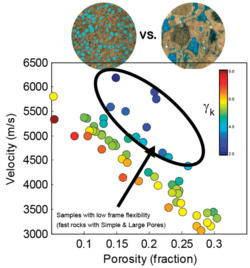
In earlier studies we documented the importance of pore structures on velocity at a given porosity, and qualitatively related pore types to these velocity variations. Digital image analysis of pore structures yield a quantitative way to estimate their influence on sonic velocity and permeability. In addition, high-resolution CT–scans of plug samples increases our pore structure analysis from 2-D to 3-D. Over the last years we started to assemble a data-base on dolomites and plan to focus on the sonic velocity and permeability in dolomites to get a better understanding of the petrophysical behavior of various types of dolomite. 
Core material from several drill sites are used for integrated studies of the sedimentologic, diagenetic, petrophysical characteristics of oolithic grainstone bodies which determine the influence of early cementation on sonic and hydraulic properties, and the cause for the heterogeneity in such oolithic grainstone settings.

Current Projects


Pore Throat Dimensions, “Apparent Cross-sectional Area”, and Electrical Resistivity in Low Porosity Carbonates

Norbisrath_2011

Project Media
     
Norbisrat...ctus.pdf
Media Type:Article
File Size:615KB


Investigators: Jan H. Norbisrath, gregor P. Eberli, and Ralf J. Weger

Previous studies by Verwer et al. (2011) have shown that the electrical resistivity and Archie’s cementation factor, m, in carbonates are mainly controlled by the fluid filled pore structure. Their most arresting finding is that samples with simple, large pore structures and high permeability tend to have higher resistivity than samples with similar porosity but small, complex pore structures dominated by small pores and lower permeability. Verwer et al. (2011) hypothesize that this trend is related to the “apparent cross-sectional area”, which rises with the increasing number of pore throats in microporous, low permeability carbonates. In this study, we test this hypothesis by assessing the complex relationships between the electrical resistivity and the pore structures in both low porosity rocks and highly microporous rocks.


Rock Fluid Interaction: Velocity Evolution during Controlled Precipitation and/or Dissolution

Weger_2011

Project Media
     
Weger_201...AAPG.pdfsponsors only content
Media Type:Poster
File Size:3MB
Weger_eta...ctus.pdf
Media Type:Article
File Size:146KB


Investigators: Ralf J. Weger, Peter K. Swart, and Gregor P. Eberli

Carbonates are prone to diagenetic alterations that result in changes of the petrophysical properties. Small amounts of newly formed contact cement can stiffen the rock. Similarly, dissolution from slightly acidic formation waters or acid treatment during well completion can result in secondary porosity and increased permeability. Although these processes are well known, little data exists to quantify these changes and their influence on petrophysical properties. In this project, experiments that quantify both the chemical changes in the fluids and the diagenetic and petrophysical changes in the rocks are designed to enhance our understanding of the effects of chemical rock-fluid interaction. In particular, the study will capture changes of acoustic velocity and permeability during chemically controlled rock-fluid interaction that causes either precipitation or dissolution of the rock.


Petrophysical Characterization of Carbonate Turbidites in Outcrop and Subsurface, Maiella Platform, Italy

Maura_2011

Project Media
     
Maura_eta...ctus.pdf
Media Type:Article
File Size:532KB


Investigators: Irena Andisa Maura, Gregor P. Eberli, and Daniel Bernoulli

In the search for new plays in carbonates, slope sections and calcareous turbidites, breccias, and megabreccias have received renewed attention. To date, only a few reservoirs are producing from carbonate breccias and/or calcareous turbidites. In a previous project, we assessed the reservoir potential of the re-deposited carbonates in the slope sections and the basin adjacent to the Maiella platform exposed in the Abruzzi, Italy. The aim of this follow-up project is to assess the porosity and permeability in a core from the Adriatic offshore through the time equivalent sections in the subsurface portion of the Maiella platform margin.


Fracture Properties from 3D GPR Diffractions  

Grasmueck_2011

Project Media
     
Grasmueck...ctus.pdf
Media Type:Article
File Size:148KB


Investigators: Mark Grasmueck, Michael A. Pelissier, and Tijmen Jan Moser

Recent advances in high-resolution 3D GPR imaging show how complex fracture networks, including millimeter thin sub-vertical joints, can be delineated with the help of diffractions previously considered as noise. For the visualization of the fractures, the 3D GPR data have to be migrated to focus the diffractions. The fracture planes appear as alignments between focused diffractions events. This project addresses the origin of individual diffractions caused by fractures. To move from pure delineation of fractures to quantification of fracture properties, a detailed understanding of diffraction mechanisms is necessary.


4D GPR for Fluid Flow Quantification in Fractured Carbonates: Cretaceous Orfento Formation, Madonna della Mazza, Italy

Marchesini_2011

Project Media
     
Marchesin...AAPG.pdfsponsors only content
Media Type:Presentation
File Size:5MB
Marchesin...ctus.pdf
Media Type:Article
File Size:218KB


Investigators: Pierpaolo Marchesini, Mark Grasmueck, and Gregor P. Eberli

Characterization of the parameters controlling fluid flow mostly relies on 0.01-0.1 meter scale lab measurements, up scaling, and modeling. To visualize and quantify fluid flow at a more realistic scale of 1-10 meters, we conducted a field experiment injecting and monitoring a moving water mass into a fractured grainstone reservoir analog. 4D GPR is used in this study to quantify local water content changes, delineate wetting and drainage zones, and determine the influence of faults and deformation bands on fluid flow. Characterizing the dynamics of fluid flow in a porous matrix is possible because of variations detected in the GPR response between time-lapse data. Quantification of fluid flow within a network of faults and deformation bands helps in perfecting flow models and residual fluid recovery.


Petrophysical Properties and Pore Structures of Stromatolites and Travertine

Rasmussen_2011

Project Media
     
Rasmussen...ctus.pdf
Media Type:Article
File Size:282KB


Investigators: Cornelia Rasmussen, Gregor P. Eberli, and Ralf J. Weger

The pre-salt reservoir facies located offshore Brazil is reported to consist predominantly of microbialites reminiscent of either stromatolites precipitating in a lacustrine setting or travertine. There is a general consensus that no modern environment can serve as an exact analog for these Cretaceous deposits. Furthermore, the pre-salt rocks are not uniform across the entire basin and thus, depending on the location the reservoir facies, might resemble stromatolites or travertine. Both deposits have recently received attention but mostly in regards to the biological interaction involved in their genesis. What is lacking is petrophysical characterization of these deposits and comparisons between them that can serve as a guide for the petro-seismic distinction of similar pre-salt rocks.


Petrophysical Characterization of Danian Deep-Water Coral Mounds, Faxe, Denmark

Eberli_Faxe_2011

Project Media
     
Eberli_et...ctus.pdf
Media Type:Article
File Size:295KB


Investigators: Gregor P. Eberli, Cornelia Rasmussen, and Ida Fabricius

Deep-water corals form impressive mounds up to 180 m high in the modern oceans. For example, the 155 m high Challenger Mound in the Porcupine Basin is constructed by an alternation of coral floatstone and wackestone units. In the Straits of Florida, mounds can be as high as 120 m and coalesce to form kilometer long ridges. Thus, their size and abundance make them potential but hitherto unexplored reservoirs. Little is known about the petrophysical properties of these mounds. In the early Cenozoic strata (Middle Danian) of Denmark, large reefal mounds, similar in size and shape to modern ones, occur in deep-water carbonate settings. In the Faxe quarry, the reefal limestone and its associated facies are mined and can be sampled for a petrophysical characterization of these mounds.


||©Comparative Sedimentology Laboratory 2004||